|
> FLOWing with John Mackey, CEO of Whole Foods Market and co-founder of FLOW.
> Link to Articles by Michael Strong, CEO & Chief Visionary Officer of FLOW.
>Integral Business - Excerpts from a conversation between John Mackey & Ken Wilber.
>Download a summary of Working for Good-2: Peace Through Commerce
>We invite you to enter the Working for Good BUSINESS PLAN COMPETITION.
|
|

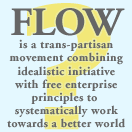
What does 'FLOW' mean?
The name “FLOW” has two primary roots:
- An optimal state of human experience in which individuals are fully engaged in creative endeavors, experiencing fulfillment, happiness, and well-being. This state is articulated by psychologist Mihaly Csikszentmihalyi in Flow: The Psychology of Optimal Experience.
- The means by which increases in the free global flow of goods, services, capital, people, and information will accelerate human progress and well-being.
We believe that the entrepreneurial spirit fosters the flow state, and entrepreneurial creativity and innovation can create conditions that promote sustainable peace, prosperity, and happiness for all, in the next 50 years.
The name FLOW was discovered by John Mackey after an early work session in which more concrete, descriptive terms (such as “Realistic Visionary” and “Voluntarist Idealists”) had been considered and rejected.
Aren’t FLOW’s stated goals of achieving peace, prosperity, happiness and sustainability in 50 years idealistic?
Yes, exceedingly so. Indeed, they are possible if and only if we are able to obtain the commitment and cooperation of thousands of motivated idealists and creative entrepreneurs who understand the role of freedom, property rights, and rule of law, on the one hand, and creativity, innovation, and entrepreneurship, on the other hand, in creating a better world.
These fundamental classical liberal institutions first received widespread acceptance in late 18th and early 19th century Britain and the U.S. Not even the most wild-eyed idealist in 1800 could have predicted the fantastic increase in working class standards of living that followed.
Similar institutions followed in the rest of Europe in the first half of the 20th century, and among Japan, South Korea, Taiwan, Singapore, and Hong Kong in the second half of the 20th century, resulting in similarly remarkable gains in the standard of living of the masses.
Today Chile, China, India, Dubai, Ireland, and the Baltic Republics are beginning to implement classical liberal principles and allowing their peoples to improve their standards of living. In the last ten years Ireland has moved from among the poorest of EU nations to among the wealthiest due largely to the implementation of classical liberal principles.
What does FLOW do? What specific, real-world initiatives and activities are involved in reaching these goals?
FLOW will create a community and public identity associated with the idealistic principles outlined herein. We intend to support existing agents for the good rather than to initiate projects ourselves. Some of the ways in which we intend to create and support such a community include:
- On-line community
- Participating in and producing events
- Catalyzing FLOW study groups and action circles
- FLOW books and other publications
- Contests
How do I become a member?
Anyone who agrees with FLOW's vision and in non-coercive solutions toward that vision are invited to become a member of FLOW and enjoy the benefits of membership. We invite you to join FLOW here.
Why does FLOW emphasize entrepreneurial, market-based means of achieving its goals?
Voluntaristic, freedom-based approaches to human betterment can be orders of magnitude more effective than command and control solutions based on conflict and coercion. These classical liberal principles have proven their effectiveness, relative to other approaches to human betterment, again and again.
A vignette: By the mid-1980s, a decent university in the U.S. had more computing power than the entire Soviet Union. Computing power is mostly a result of math, sand, and freedom. The Soviet Union had the best mathematicians on earth and plenty of sand, but without freedom, they were unable to create a vibrant, innovative, IT industry that continually produced cheaper, better, and more amazing products and devices. Critical to this act of creation was the opportunity for young, untrained, uncredentialed, amateurs to play around with gadgets in their own ways, to link together with other amateur geeks, and to create organizations and seek funding under the protection of laws that supported property rights and contract.
This vignette is a parable for all of life: In the fields of education, law, therapeutic intervention, medical care, and more, when thousands of amateurs are allowed to create new and more wonderful ways of learning, adjudicating disputes, and healing minds, bodies, and spirits, we will then see solutions to our most vexing problems that are orders of magnitude more effective than what we have today.
Submitting crucial aspects of human existence, such as education, community formation, and health care to the political control is a certain means of delaying progress and ensuring that problems remain intractable. Political decisions are slow, costly, and often based on conflict. Voluntary solutions are fast, creative, evolving, and more frequently based on win-win principles. We want to develop cadres of creative young people who look for voluntaristic, creative win-win solutions to problems that were previously “solved” by means of political conflict.
FLOW is committed to entrepreneurial, voluntaristic solutions because we believe in the Creative Powers of a Free Civilization (see Hayek essay by this title).
How is FLOW different from other organizations promoting social entrepreneurism?
FLOW supports all entrepreneurial efforts that result in human betterment, be they explicitly “social entrepreneurship” or otherwise. We benefit from automobiles and refrigerators, birth control and year-round fresh produce, computers and cell phones through the efforts of many thousands of entrepreneurs and their resulting businesses. While FLOW recognizes that businesses have not always pursued human well-being as consistently in the past as they ought to have done so, on balance FLOW recognizes that the process of creativity, innovation, and entrepreneurship, whether implemented by large for-profit corporations, isolated individuals, family businesses, or non-profit organizations have collectively provided extraordinary gifts to humanity.
In addition to our much broader vision of “social entrepreneurship,” FLOW has a more comprehensive, far-reaching vision than is characteristic of more specialized social entrepreneurship organizations. We wish to weave together the work of existing social entrepreneurship organizations along with the work of mainsream entrepreneurs and businesses, policy analysts, thinkers, and activists to create an integrated web of individuals working together to create a better world based on a realistic, effective plan. (Our “Open Source Business Plan for Making the World a Better Place.”)
Where does FLOW receive its funds?
From a diverse set of individual supporters, including John Mackey, Vidar Jorgensen, Bob Chitester, Susan Niederhoffer, Jim Von Ehr, Chad Thevenot, and Philip Sansone.
Are contributions to FLOW tax deductible?
Yes. FLOW is a 501(c)(3) organization.
Where is FLOW based?
Our current offices are in Austin,TX and San Rafael, CA. The FLOW Board and Executive Team are located across the country and our members are located all over the world. FLOW is constantly expanding and is likely to have a growing number of global offices.
Is FLOW affiliated with particular political, religious or other institutions?
No. FLOW members include individuals from an exceptionally diverse collection of political, religious, cultural, ethnic, and professional communities. FLOW members are united by a collective commitment to the creation of global peace, prosperity, happiness, and sustainability by means of our core principles (voluntarism, human flourishing, and radical tolerance).
FLOW seeks to create a world in which we learn to live and let live, in which we no longer seek to coerce each other out of fear and insecurity, but rather support and tolerate difference based from a position of fullness and love.
Does FLOW have a political agenda?
FLOW is not a political organization. However, insofar as we passionately believe in "liberating the entrepreneurial spirit for good," our educational efforts may include examining ways in which we can reduce the extent to which individuals use government to coerce other individuals. The primary case in which new governmental structures may need to be developed, within which the entrepreneurial spirit may then be liberated, pertains to those environmental "tragedy of the commons" problems in which new property rights systems may need to be created.
Why is FLOW concerned with achieving human happiness? Does this mean the organization has a spiritual mission?
FLOW believes that people by nature desire to seek happiness and well-being for themselves and their families. Insofar as each of us seek happiness and well-being for ourselves, simply by means of the Golden Rule we should likewise seek to create a society in which others have the opportunity to pursue happiness and well-being in their own ways. Given FLOW’s commitment to radical tolerance, we nonetheless understand that paths to happiness are as diverse as human nature. FLOW does not endorse any particular secular, religious, spiritual, cultural, or vocational path to happiness and well-being.
FLOW has tremendous respect for individual autonomy, including the individual desire to join communities. One of FLOW’s commitments is to allow for new institutional structures that allow diverse communities to create ways of living that allow for ever deepening levels of human happiness and well-being. Educational freedom will be key to this aspect of FLOW – the freedom for families to choose the manner in which their young people are educated.
|
|



















